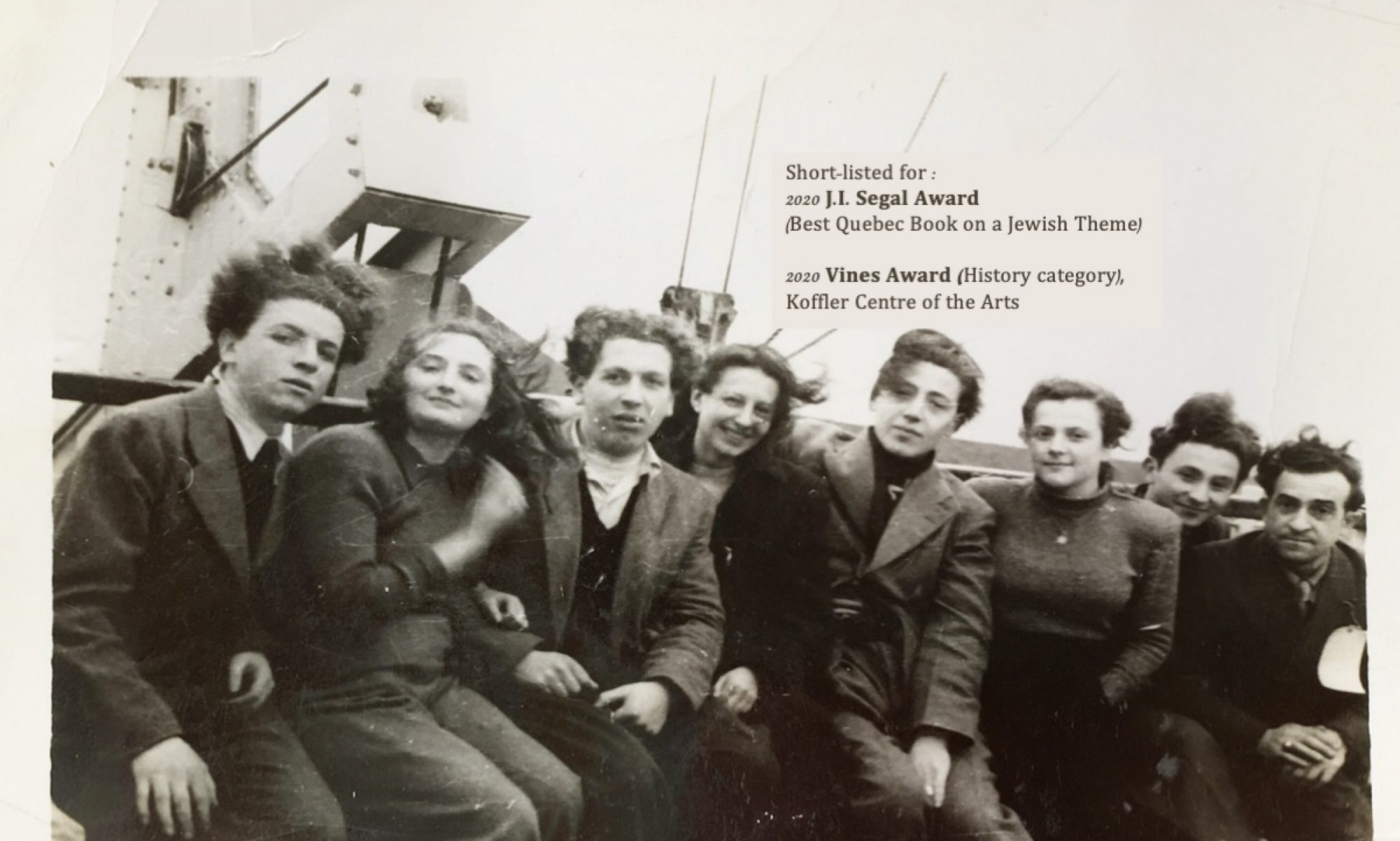
Here are three excerpts from The Montreal Shtetl...
Uprooting
I was 15 when I was liberated from Dachau in April 1945. I knew both my parents were murdered. I needed to sneak into Hungary to see if I could find my sister or any relatives. I didn’t find anyone So I left Hungary and joined up with my group of friends from Dachau in Feldafing, a DP camp in Germany.
We did everything together, went everywhere together and planned to leave together. We would have gone anywhere to get out of Germany. We applied to Australia, to United States. We didn’t at first apply to Canada, because there was no immigration to Canada; you know the story. But what happened is the Canadian Jewish Congress, in 1947, convinced the Canadian government to give 1,000 visas for those under18 years old who had lost their parents. It was called the Orphan programme. Was I under 18? It was three years after the war. How many 15 year-olds survived the war? Very, very few. Everybody had to be over 18. You did whatever you could to leave Europe. So Canada came up first, and I said, “I didn’t care.” I didn’t know anything about Canada. All I remember learning in school was the big lakes, the Great Lakes. ~Paul ~
Unpacking
When we first arrived in Montreal, we stayed with our cousins for about two weeks and then rented a room near Van Horne and Esplanade, which was 55 dollars a month. I do remember that was a lot of money. My parents paid more rent for the room than these people paid for the whole house.
My father was trained as a sheet metal worker in Poland. He couldn’t get a job. You needed connections, and no one he knew had connections, because it was considered a French trade. He was willing to do anything, even work in the needle trade. After a year, he found a job as a roofer.
My mother was a dressmaker and a designer, and she was able to find work right away. She got work in a factory, making about 18 dollars a week as a sewing machine operator. She got paid by piecework. My mother still did everything around the house. The factory where she worked was on Mount Royal and Jeanne Mance, over two kilometres away from where we lived. Every day she would walk home to give me lunch and then walk back to save the streetcar ticket, which was 25 cents.
We did not stay long at this flat. It was too expensive. We then moved to a third-floor triplex on Esplanade and Villeneuve. When we moved here, my mother bought a Singer sewing machine and, in the evenings, she would sew for private customers as well as bring piecework home from the factory. Our first year in Montreal was so, so difficult. ~Sonja~
Making Home
At that time, the Jewish Canadian community didn’t want to talk about the Holocaust. It wasn’t elegant. It wasn’t nice. They didn’t want to know. They had no interest. You know, I remember going to France; people talked about the war, people talked about the camps; people talked about what they lived through. And in Canada and the United States, you didn’t talk about it. There was no integration. We had a group of friends, immigrants, most of them I met here, people usually with the same interest. People that were more secular. I was not religious whatsoever. We got together, we liked to talk or read a book at the Jewish Public Library. Some of us formed long friendships; with others they were short. I had a huge group of people that we met together, we spent holidays together, our kids know each other even until now, if there’s anybody left. I didn’t form any true friendships with Canadian Jews. When I think about it, I, most probably, didn’t want to. Socially, I could not, nor could they. We lived parallel lives.
Those first 10 years in Montreal were really tough. There was nothing here. I was never well-suited for homemaking. I did not enjoy staying home, but there was nothing I could do. I was constantly frustrated. I couldn’t go to work. There was no daycare whatsoever. You could not ask a friend to take care of your child in the same way you can ask your sister or your mother. Everyone was so overworked and so overwhelmed, with no support.
So what changed for me?
Assimilation is a strange thing. It’s a hard thing. It’s a very gradual process. In the beginning, you hate it. “I can’t be like them.” Then you start to mellow. You think, “If I’m going to be like them, that’s how it is.” Then you accept it. I grew to love this place, and I felt that I belong. ~Theresa~
 The Montreal Shtetl